Multi-Agent vs Chains - when graph, when chain?

The problem: which pattern to choose?
You're building an AI system and facing an architecture choice. LangChain offers chains - sequential pipelines. LangGraph provides graphs with cycles and multi-agents. Which to choose?
The answer isn't obvious. Research from late 2025 shows that more agents doesn't always mean better results. In tasks with more than 10 tools, multi-agent systems lose 2-6x efficiency compared to single agents.
Chain - sequential processing
How it works
A chain is a DAG (Directed Acyclic Graph) - tasks execute sequentially, no loops. Each step passes results to the next.
Input → Retrieve → Process → Generate → OutputLangChain example
pythonfrom langchain_core.prompts import ChatPromptTemplate
from langchain_openai import ChatOpenAI
from langchain_core.output_parsers import StrOutputParser

prompt = ChatPromptTemplate.from_template(
    "Summarize this text: {text}"
)

chain = prompt | ChatOpenAI() | StrOutputParser()

result = chain.invoke({"text": "Long document..."})
When is chain enough?
- RAG - retrieve → augment → generate
- Summarization - one document, one result
- Classification - input → analysis → category
- Transformations - format A → format B
Graph - non-linear flows
How it works
Graphs allow cycles, branching, and dynamic decisions. An agent can return to a previous step, choose a different path, iterate until success.
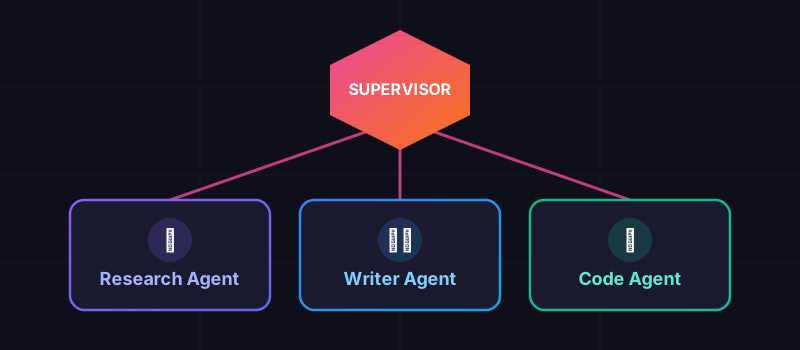
LangGraph example
pythonfrom langgraph.graph import StateGraph, START, END
from typing import TypedDict

class State(TypedDict):
    messages: list
    next_agent: str

def supervisor(state: State) -> dict:
    # Decides which agent should act
    return {"next_agent": "research"}

def research_agent(state: State) -> dict:
    # Searches for information
    return {"messages": state["messages"] + ["Found data..."]}

def writer_agent(state: State) -> dict:
    # Generates response
    return {"messages": state["messages"] + ["Here's the report..."]}

graph = StateGraph(State)
graph.add_node("supervisor", supervisor)
graph.add_node("research", research_agent)
graph.add_node("writer", writer_agent)

graph.add_edge(START, "supervisor")
graph.add_conditional_edges("supervisor", lambda s: s["next_agent"])
graph.add_edge("research", "supervisor")
graph.add_edge("writer", END)

app = graph.compile()
Comparison: Chain vs Graph
| Aspect | Chain (LangChain) | Graph (LangGraph) |
|---|---|---|
| Flow | Linear, sequential | Non-linear, with cycles |
| State | Passed between steps | Central, shared |
| Debugging | Simple | Requires tools (Studio) |
| Complexity | Low | High |
| Use cases | RAG, simple pipelines | Multi-agent, iterations |
Supervisor Pattern - agent coordination
In a multi-agent system you need a coordinator. Supervisor Pattern is an architecture where a central agent decides which specialized agent should act.
When Supervisor?
- You have different domains - calendar, email, CRM, database
- Each domain has complex logic or many tools
- You need centralized control of the flow
When single agent?
- You have few simple tools
- Tasks are homogeneous
- You want a quick prototype
Research: more agents ≠ better
Research from 2025 (Stanford, Harvard, Google) shows surprising results:
Tool-heavy environments
In environments with >10 tools, multi-agent systems lose 2-6x efficiency. Coordination overhead outweighs specialization benefits.
Financial analysis
For financial tasks, centralized multi-agent (supervisor + sub-agents) gave 80% better results than a single agent. But independent multi-agent was only 57% better.
Conclusion
"Multi-agent effectiveness depends on trade-offs between architecture and task characteristics."
When to choose what?
Stay with Chain when:
- Workflow is linear and predictable
- You need a quick MVP
- You have simple RAG or summarization
- Team has no experience with graphs
Choose Graph when:
- You need iterative loops (agent improves its work)
- You have conditional branching (different paths for different cases)
- You're building a multi-agent system with specialized roles
- You need checkpoints and resumption
Avoid multi-agent when:
- You have many tools (>10) in one agent
- Tasks are homogeneous
- You don't have time to test interactions between agents
Practical path
1. Start with a single agent
pythonfrom langchain_openai import ChatOpenAI
from langchain_core.tools import tool

@tool
def search_database(query: str) -> str:
    """Searches the database."""
    return f"Results for: {query}"

llm = ChatOpenAI().bind_tools([search_database])
2. When complexity grows - add LangGraph
pythonfrom langgraph.prebuilt import create_react_agent

agent = create_react_agent(
    model=ChatOpenAI(),
    tools=[search_database],
    checkpointer=memory  # State persistence
)
3. When you need specialization - Supervisor
pythonfrom langgraph.graph import StateGraph

# Supervisor decides, agents execute
graph = StateGraph(State)
graph.add_node("supervisor", supervisor_node)
graph.add_node("researcher", research_agent)
graph.add_node("writer", writer_agent)
Summary
| Task complexity | Recommendation |
|---|---|
| Simple (RAG, summary) | Chain (LangChain) |
| Medium (iterations, conditions) | Graph (LangGraph) |
| High (multi-domain) | Supervisor + sub-agents |
| Very high (>10 tools) | Single agent (!!) |
Don't overcomplicate without need. A single well-configured agent often beats an army of poorly coordinated agents.
Learn more
- LangGraph - Official Documentation
- LangChain - Getting Started
- Microsoft - Single vs Multi-Agent Architecture
- OpenAI - Best Practices for Agents
Need help with AI architecture? Contact me - I'll help choose the right approach for your case.